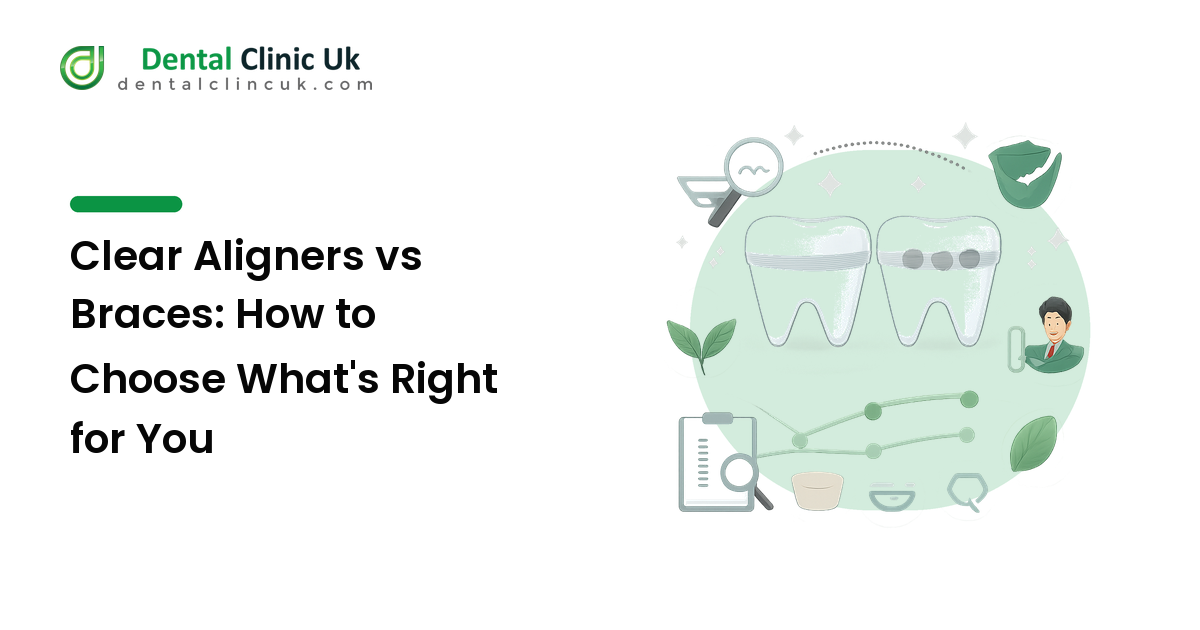
If you want straighter teeth, the decision usually comes down to two routes: clear aligners or traditional braces. Both do the same underlying job — moving teeth into a better position with steady, gentle pressure over months — they just go about it in different ways, at different price points, and with different trade-offs in comfort and appearance.
The short version: braces are fixed to your teeth and tend to handle complicated movements reliably, while clear aligners are removable and far less noticeable and suit mild-to-moderate cases very well. Neither is "better" across the board — the right choice depends on how much your teeth need to move, your budget, and how each fits your daily life. A professional assessment turns that into a confident decision.
A quick note: This article is general information only, not a diagnosis or a treatment plan. Which option suits you depends on your individual teeth, bite, and gums, which only a registered dentist or orthodontist can assess. Always get a professional opinion before starting any treatment.
How each option actually works
Traditional braces use small brackets bonded to the front of each tooth, linked by a thin archwire. At regular visits the wire is adjusted, and over time it guides your teeth along a planned path. They come in a few forms: familiar metal brackets, tooth-coloured ceramic brackets that blend in more, and lingual braces fitted behind the teeth so they are hidden from view. The defining feature is that they are fixed — they work 24 hours a day whether you think about them or not.
Clear aligners are a series of custom-made, transparent plastic trays that fit snugly over your teeth. Each tray is shaped slightly differently from the last, so swapping to the next one every week or two nudges your teeth a small step further. The best-known brand is Invisalign, but several systems now exist. The catch is discipline: aligners only work if you wear them for around 20 to 22 hours a day, taking them out mainly to eat, drink anything other than water, and clean your teeth.
The core difference, then, is fixed versus removable — and with removable comes the question of who keeps the treatment on track: the appliance, or you.
Clear aligners vs braces at a glance
| Feature | Clear aligners | Traditional braces |
|---|---|---|
| Visibility | Very discreet, often barely noticeable | Metal is visible; ceramic and lingual less so |
| Removable | Yes — take out to eat and clean | No — fixed until treatment ends |
| Best suited to | Mild-to-moderate crowding and spacing | Mild through to complex cases |
| Typical treatment time | Often around 6–18 months | Often around 12–24 months, longer if complex |
| Eating and cleaning | Remove to eat; brush and floss as normal | Food restrictions; cleaning takes more effort |
| Relies on your discipline | Yes — must be worn 20–22 hrs/day | No — always working |
| Comfort | Smooth edges; some tightness with each tray | Brackets/wires can rub at first |
| Rough private UK cost | Often around £2,000–£4,500 | Often around £1,500–£4,000+ |
Treat these numbers and timings as general guides, not promises.
What each costs in the UK
Cost is where people most want a straight answer, and honestly it varies widely with your case, the appliance, and where you go. As a rough guide for private treatment, fixed metal braces often fall around £1,500–£3,000, tooth-coloured ceramic braces a little higher, and hidden lingual braces the most expensive — sometimes £3,000–£6,000 or more. In-clinic clear aligners such as Invisalign commonly sit around £2,000–£4,500, rising with the complexity of the work.
On the NHS, orthodontic treatment is free for under-18s who qualify on clinical need (assessed with a standard scoring system), and it usually means metal braces rather than aligners or other cosmetic options. For adults, NHS orthodontics is generally only available in the uncommon cases where there is a clear clinical need, so most adults pay privately.
You may also see cheaper mail-order or "at-home" aligners advertised, often around £1,000–£2,000. Whatever route you consider, get an in-person assessment and a written quote — including retainers afterwards — before you commit.
Comfort, appearance, and everyday life
For many people this is the deciding factor, because it is what you actually live with for a year or more.
Clear aligners win on discretion and flexibility. They are hard to spot, you take them out to eat so there are no food restrictions, and you brush and floss normally. The trade-offs: each new tray can feel tight for a day or two, some people notice a brief lisp at first, and you must be disciplined about wearing them and not losing a tray.
Traditional braces ask nothing of your willpower — being fixed, they simply get on with it. The trade-offs run the other way: you avoid hard and sticky foods, cleaning around brackets and wires takes more care (interdental brushes or floss threaders help), and brackets can rub or cause the odd mouth ulcer early on. Metal is the most visible option, though ceramic or lingual braces soften that.
Which problems each handles best
Both options straighten teeth, but they are not equally suited to every case.
- Mild-to-moderate crowding or gaps: both work well, and this is where clear aligners are especially popular.
- Rotations, large gaps, and bigger movements: fixed braces often move teeth more predictably here, because the wire can apply forces that trays find harder to deliver.
- Bite correction and complex cases: significant bite problems, or teeth that need to travel a long way, are frequently better handled by braces, sometimes combined with other appliances.
This is why a professional assessment matters more than any online comparison. An orthodontist examines your teeth, bite, and often X-rays, then tells you which approaches can realistically achieve your goal — and sometimes both are viable, leaving the choice to lifestyle and budget.
How to choose: a short checklist
One safeguard applies whichever option you pick. Straightening moves teeth through the bone that holds them, which is only safe on healthy foundations — so hidden decay, gum disease, or loose teeth should be treated first. It is also why cheap mail-order aligners, which skip the in-person exam, X-rays, and monitoring, carry more risk. As with any cosmetic dental decision, including whether to brighten your smile afterwards, a check-up first protects you; our guide on whether teeth whitening damages your teeth makes the same point.
With that in mind, run through these questions before you decide:
- How much do my teeth need to move? Minor tweaks open up more options; complex cases may point towards braces.
- How important is discretion? If barely-visible treatment matters to you, aligners or ceramic/lingual braces are worth pricing up.
- Will I really wear aligners 20–22 hours a day? Be honest — if not, fixed braces remove that risk.
- What is my realistic budget, including retainers to hold the result afterwards?
- Am I eligible for any NHS help, or will this be private?
- Are my gums and teeth healthy enough to start? A check-up answers this.
There is no single winner — only the option that best matches your teeth, budget, and day-to-day. Take your answers to a consultation.
Frequently asked questions
Are clear aligners as effective as braces?
For mild-to-moderate crowding and spacing, well-managed clear aligners can achieve excellent results. For rotations, large gaps, or complex bite problems, fixed braces are often more predictable. Effectiveness also depends on wearing aligners as instructed — around 20 to 22 hours a day. An orthodontist can tell you whether aligners will meet your specific goal.
Do clear aligners or braces cost more?
It varies by case, but in the UK the two overlap. Standard metal braces are often the most affordable route privately, in-clinic clear aligners tend to sit in the mid-to-upper range, and hidden lingual braces are usually the priciest. Always get a written quote that includes retainers.
Which is faster, aligners or braces?
Neither is reliably faster — it depends on your teeth. Straightforward cases treated with aligners can take roughly 6 to 18 months, while braces often run around 12 to 24 months, with complex cases longer either way. The amount of movement needed matters more than the appliance.
Can I get braces or aligners on the NHS?
Under-18s who qualify on clinical need can usually get free treatment, generally with metal braces rather than aligners. For adults, NHS orthodontics is limited to uncommon cases with a clear clinical need, so most adults pay privately. Your dentist can advise on eligibility.
Do braces or aligners hurt?
Expect pressure or tenderness rather than pain, especially in the first days and after each adjustment or new tray — a sign the teeth are moving. Braces can also rub the cheeks or lips at first. Any severe or lasting pain is worth raising with your orthodontist.
Can I switch between them, or use both?
Sometimes. Plans can combine approaches — for example a short spell in braces followed by aligners — and are occasionally adjusted mid-course. That is a decision to make with your orthodontist, based on how your teeth respond.
Next step
Clear aligners and braces are both proven ways to straighten teeth; the "best" one is simply the option that fits your teeth, your budget, and your lifestyle. Aligners offer discretion and flexibility if you will wear them faithfully, while braces quietly handle complex movements without relying on your willpower. The way to decide with confidence is to have your teeth and gums assessed in person. Speak to the team at Dental Clinic UK to talk through the option that suits you best.