If you are trying to decide between an NHS and a private dentist, you are weighing up a genuinely practical question, not just a matter of budget. The two routes can deliver the same everyday care — a check-up, a filling, an extraction — but they differ in what they cost, how they charge, how easy they are to get onto, and how much choice and time you get. Understanding those differences makes the decision far less daunting.
The short version: NHS dentistry provides the treatment you clinically need to keep your mouth healthy, charged at set national bands and often the cheaper route, though NHS places can be harder to find in some areas. Private dentistry costs more and is priced by the practice, but typically offers more appointment flexibility, a wider range of options, and cosmetic treatments the NHS does not cover. Neither is simply "better" — the right choice depends on what you need, what is available near you, and what you are comfortable paying.
A quick note: This article is general information only and is not a diagnosis, a treatment recommendation, or a substitute for professional dental advice. NHS eligibility, charges, and what is right for your own mouth all depend on your circumstances and where you live in the UK, and only a registered dentist can assess your individual needs. Always check current rules and charges with an official source and speak to a dental professional about your own situation.
What "NHS" and "private" actually mean
Both NHS and private dentists are fully qualified, registered dental professionals — the difference is not in their training but in how the care is funded and priced.
An NHS dentist provides treatment funded partly by the health service, so you pay a subsidised, standardised charge for clinically necessary care. The key phrase is clinically necessary: the NHS covers what you need to keep your teeth, gums, and mouth healthy and free of pain, rather than purely cosmetic work.
A private dentist is paid directly by you (or through a dental plan or insurance), and sets their own prices. Because the practice isn't working to a national fee scale, private care tends to offer more flexibility in appointments, materials, and the range of treatments on offer — including the cosmetic options the NHS generally won't fund.
Many UK practices are "mixed": they offer NHS care to some patients and private care to others, and an individual dentist may do both. So "choosing NHS or private" often happens treatment by treatment, not just once.
How NHS dental charges work
One thing that puts people off the NHS is the assumption that charges are unpredictable. In England they are actually the opposite: NHS dental treatment is grouped into a small number of fixed charge bands, set nationally, so the same treatment costs the same set amount regardless of which NHS dentist you see.
Broadly, the bands work like this:
- A band for examination and diagnosis — your check-up, advice, X-rays if needed, and usually a scale and polish where clinically appropriate.
- A band for most routine treatment — things like fillings, extractions, and root canal work.
- A band for more complex or lab-made work — such as crowns, dentures, and bridges.
- A separate urgent charge for emergency treatment to get you out of pain.
You pay one band charge per course of treatment, and if you need several things done at once, you pay the highest band that applies rather than adding them all up. Because the amounts are set nationally and updated from time to time, it is worth checking the current figures on the official NHS website rather than relying on a number you saw somewhere — that way you always have the right, up-to-date charge.
Some people don't pay NHS dental charges at all. Exemptions exist for groups such as children, and for people in certain circumstances or receiving particular benefits. The rules are specific, so if you think you might qualify, check your eligibility directly rather than assuming.
One important caveat: this band system applies to England. Scotland, Wales, and Northern Ireland run NHS dentistry differently, with their own charging arrangements and exemptions, so if you live outside England, check the rules where you are.
What private dentistry adds — and what it costs
Private care removes the band structure entirely. Instead, the practice prices each treatment itself, which means costs vary from practice to practice and are usually higher than the equivalent NHS charge. In return, you typically get more of three things:
- Flexibility. Longer or more convenient appointment slots, easier access when NHS lists are full, and sometimes a wider choice of who you see.
- Choice of materials and techniques. For example, tooth-coloured fillings on back teeth, or particular crown and denture materials, may be offered more freely privately.
- Access to cosmetic and elective treatment. This is the big one. Treatments that are about appearance rather than health — such as teeth whitening, veneers, and most adult orthodontics — are generally not available on the NHS and are provided privately.
Many private practices offer dental plans (a fixed monthly payment that spreads the cost of routine care) or accept dental insurance, which can make private care more predictable and manageable than paying per visit. As with any spending decision, it is worth understanding exactly what a plan does and doesn't include before signing up.
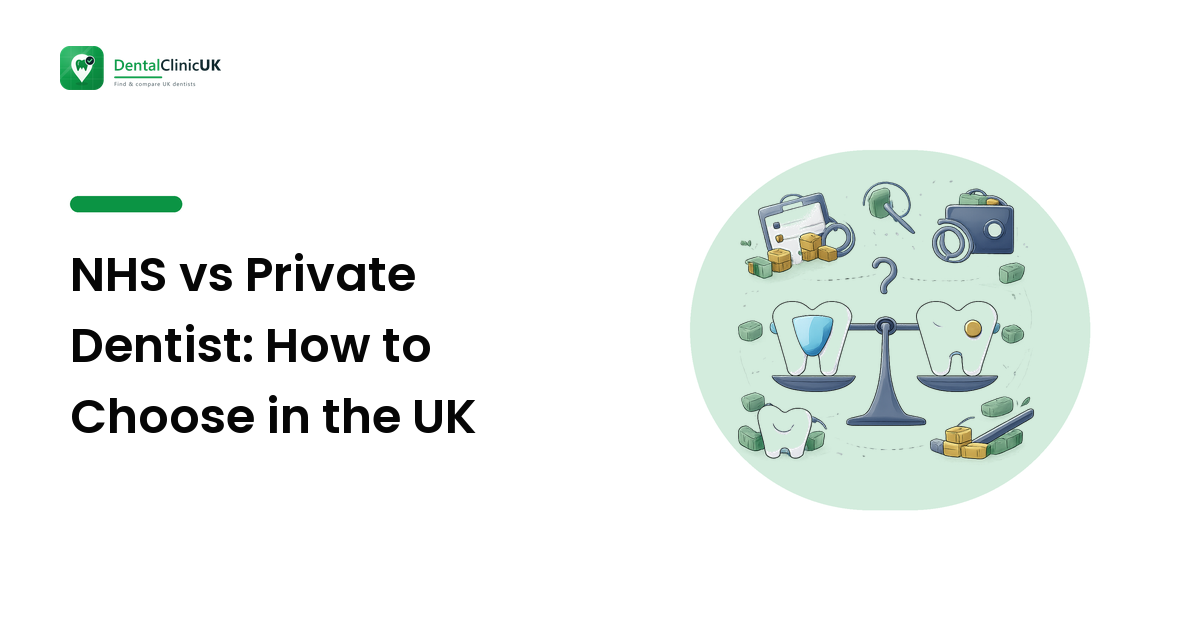
NHS vs private, side by side: the honest trade-offs
No single factor decides this. Here is how the two compare on the things that matter most.
Cost
NHS is generally cheaper for the treatment it covers, with predictable set charges. Private costs more and varies by practice, though plans can smooth the cost out. If price is your main concern and you need standard care, NHS usually wins on this measure alone.
Availability
This is where the picture has become trickier. In some parts of the UK, NHS dental places are in short supply, and a practice may not be taking on new NHS patients even if it offers NHS care to existing ones. Private appointments are often easier to get. Availability is very local, so what's true in one town may not be true in the next.
Time and convenience
Private appointments tend to be longer and easier to schedule around work or family life. NHS appointments deliver the same clinical care but can be busier and harder to book at short notice.
Range of treatment
For keeping your mouth healthy, the NHS covers what you need. But if you want cosmetic work, or a specific material or approach that isn't clinically necessary, that generally sits on the private side.
Continuity
Seeing the same dentist over time helps them get to know your mouth. Both routes can offer this, but if your area's NHS capacity is stretched, continuity can be easier to maintain privately. Whichever you choose, being seen on a sensible check-up interval matters more than the label on the practice.
Who tends to suit each route
There is no universal answer, but a few patterns are common.
NHS often suits people who want good, clinically sound care at a predictable, subsidised cost; families (children's dental care is treated favourably across the UK); and anyone whose needs are essentially about staying healthy rather than changing how their teeth look. The main practical hurdle is finding a practice with NHS capacity near you.
Private often suits people who value flexible or faster appointments, want cosmetic or elective treatment, prefer a particular material or a longer appointment, or simply couldn't find an NHS place and needed to be seen. It costs more, but for some the convenience and choice are worth it.
Plenty of people sensibly mix the two — routine NHS check-ups and treatment, with the occasional private cosmetic treatment when they want it. You are not locked in for life by choosing one today.
How to find and choose a dentist, either way
Once you have a sense of which route fits, the practical step is finding a practice that suits you. A few things are worth checking whichever you pick:
- Whether they are taking new patients — and specifically whether that includes NHS places, if that's what you want.
- What they charge or which NHS bands apply — and, for private care, whether they offer a plan.
- What treatments they offer — especially if you have a specific need like a nervous-patient service, emergency appointments, or cosmetic work.
- What other patients say — reviews and ratings can give a feel for the practice, though they are one input, not the whole story.
- Location and opening hours — a practice you can actually get to easily is a practice you'll keep going to.
Comparing a few options near you on these points — NHS and private side by side — is the quickest way to see what's realistically available and make a confident choice.
Frequently asked questions
Is an NHS dentist as good as a private one?
Yes, in terms of clinical quality. NHS and private dentists are all qualified, registered professionals held to the same standards, and NHS care covers everything clinically necessary to keep your mouth healthy. The differences are about cost, appointment flexibility, choice of materials, and access to cosmetic treatment — not the competence of the dentist.
Why can it be hard to find an NHS dentist?
In some areas, demand for NHS dental places outstrips the capacity practices have, so a practice may not be taking on new NHS patients even while it treats existing ones or offers private care. Availability is very local, so it's worth checking several practices near you rather than assuming none have space.
Can I switch between NHS and private treatment?
Often, yes. Many practices offer both, and people commonly have routine care on the NHS while choosing to pay privately for something the NHS doesn't cover, such as cosmetic work. You can also change practices. The main constraint is whether the practice you want has NHS availability.
Does the NHS cover cosmetic dentistry like whitening or veneers?
Generally no. The NHS funds treatment that is clinically necessary for your oral health, not treatment that is purely about appearance. Teeth whitening, veneers, and most adult orthodontics are usually provided privately. If a treatment is needed to keep you healthy or out of pain, though, it typically falls within NHS care.
How much does a private dentist cost compared to the NHS?
Private prices are set by each practice and are usually higher than the equivalent NHS band charge, but they vary widely, so there's no single figure. NHS charges are standardised and set nationally, which makes them predictable. For an accurate comparison, check the current NHS charges on the official NHS website and ask any private practice directly for its price list.
Next step
Choosing between an NHS and a private dentist comes down to what you need, what's available near you, and what you're comfortable paying — and for most people the honest answer is "it depends on the treatment." The good news is you don't have to guess in the abstract: the fastest way to decide is to see what's actually on offer where you live. Search NHS and private dentists near you and compare their treatments, availability, and reviews side by side at Dental Clinic UK, then speak to a practice about your own needs.