Losing a tooth as an adult is unsettling in a way that's hard to explain to anyone who hasn't. And once you start reading about replacing it, you meet a word attached to a big number: implant.
The short version: a dental implant is an artificial tooth root — a small screw-shaped post placed into the jawbone — which, once healed, holds a crown, bridge, or denture on top. It is generally the longest-lasting way to replace a missing tooth and the only option that replaces the root rather than just the visible part. It is also the most involved and the most expensive, and it isn't right for everyone. Whether it suits you depends on your bone, gums, general health, and budget.
A quick note: this article is general information only, not a diagnosis or a treatment plan. Whether an implant is suitable for you can only be assessed in person by a registered dentist, usually with X-rays or a 3D scan. Always get an individual opinion and a written treatment plan before starting anything.
What a dental implant actually is
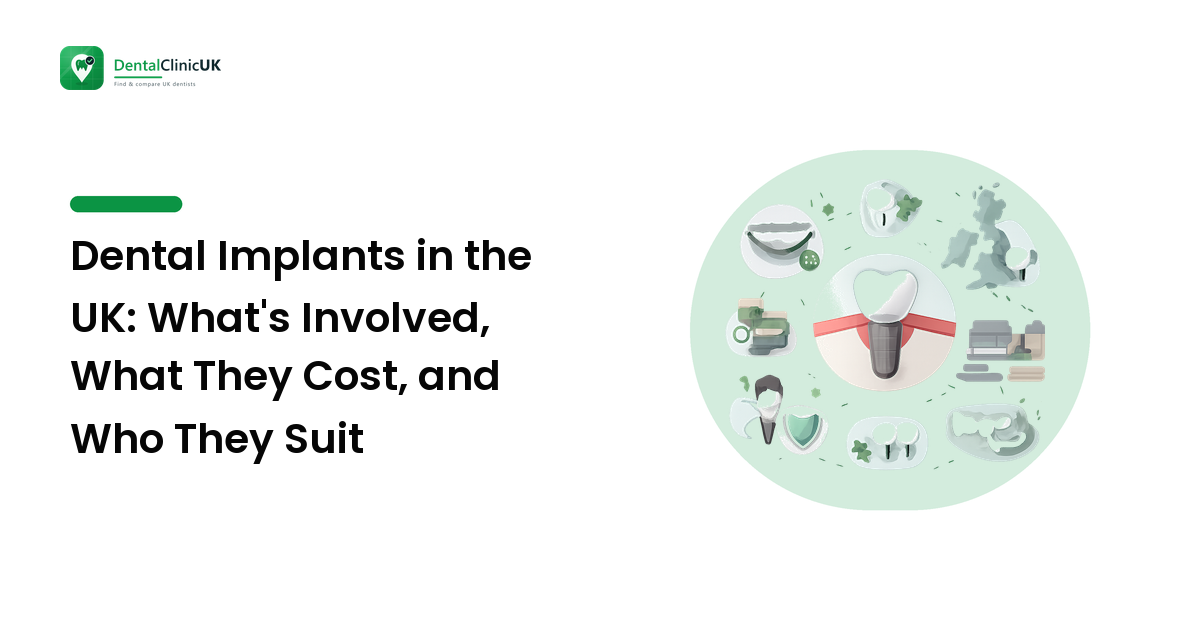
Most people picture a whole false tooth. In reality an implant has three parts:
- The implant (fixture). A small post, usually titanium and sometimes zirconia, placed into the jawbone where the natural root used to be. This is the part genuinely called the implant.
- The abutment. A connector sitting on top of the fixture, passing through the gum.
- The restoration. The visible part — a crown for a single tooth, or a bridge or denture where several teeth are missing.
What makes an implant different from a bridge or denture is osseointegration: over a few months, bone grows directly onto the post so it is held firmly rather than resting on the gum or clipping onto neighbouring teeth. That is also why implants take time — you cannot hurry bone.
The stages, and how long it takes
Timelines vary a great deal between cases, but a typical single-tooth implant journey looks like this.
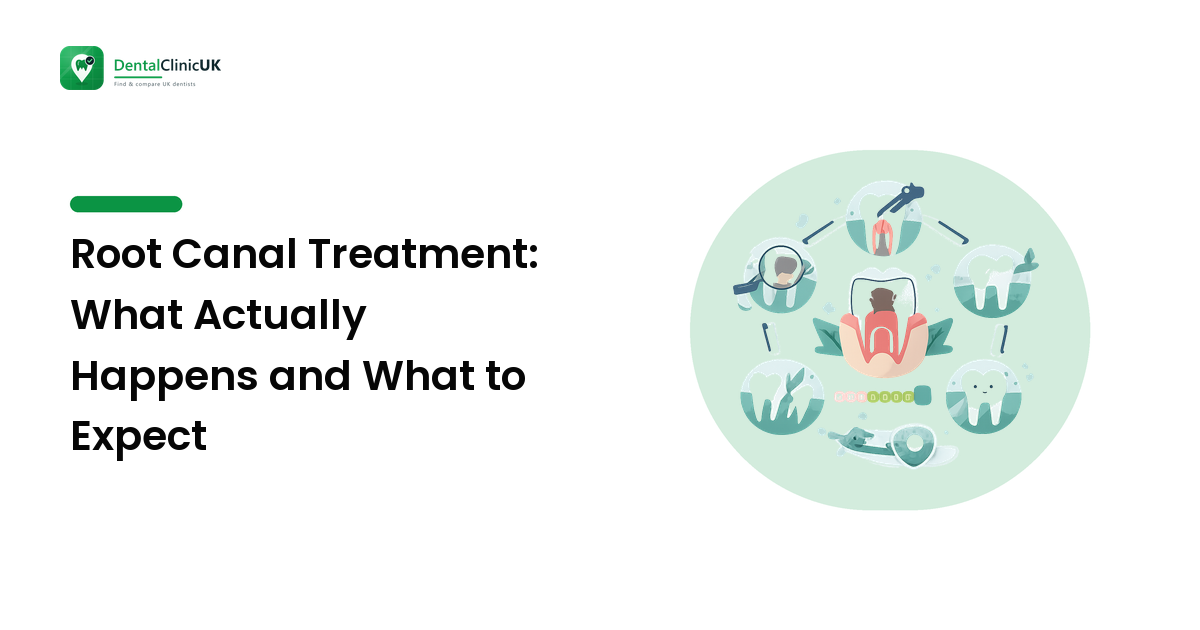
1. Assessment. A full examination of the teeth and gums, X-rays, and usually a CBCT scan — a 3D scan showing how much bone is available and where the nerves and sinuses sit. It also identifies any active gum disease or decay, which has to be dealt with first.
2. Preparation, if needed. Sometimes the tooth still needs removing. Sometimes there isn't enough bone, and a bone graft or, in the upper back jaw, a sinus lift is proposed to build up the site. Grafting adds both cost and months of healing before the implant can go in.
3. Placement. The implant is placed, normally under local anaesthetic, with sedation available at most practices if you're anxious. Patients usually describe it as more uncomfortable afterwards than during. Expect swelling and soreness for a few days.
4. Healing. The osseointegration period — commonly several months, and longer if grafting was involved. You may be given a temporary tooth so you aren't left with a visible gap.
5. The restoration. Once healed, impressions or a digital scan are taken and the final crown is made and fitted.
Start to finish, a straightforward single implant commonly spans several months; extraction and grafting take considerably longer. Some practices offer immediate placement or same-day teeth in selected cases. It suits some people and not others — the deciding factor is usually how stable the implant is at placement, which is a clinical judgement rather than a preference.
Roughly what implants cost in the UK
Prices vary by practice, location, and case complexity, so treat the following as orientation and get a written quote.
A single implant with its crown is commonly quoted from around £2,000 to £2,500 or more in private UK practice. Extras are usually priced separately: a bone graft or sinus lift adds a meaningful amount, as can a CBCT scan and sedation. An implant-supported bridge, or a full arch on multiple implants, runs into much larger sums — often five figures per arch.
Two things worth checking on any quote:
- What's included. Assessment, scans, the implant, abutment, crown, and follow-ups are sometimes bundled and sometimes not. Ask for an itemised plan.
- What happens if it fails. Ask about the practice's policy and aftercare schedule.
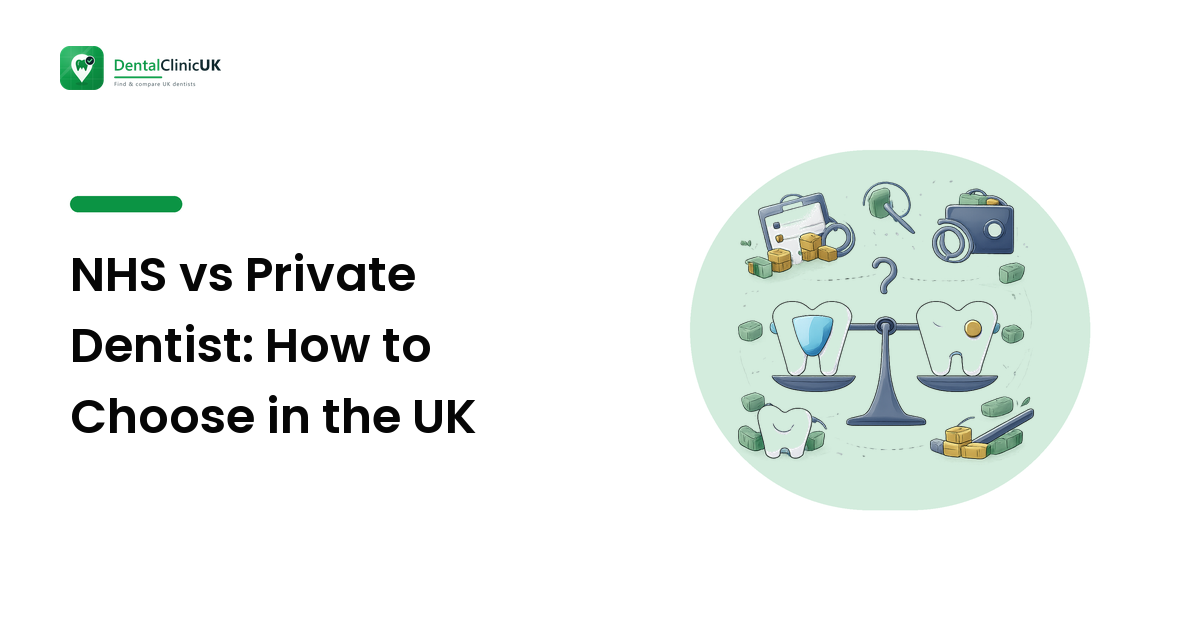
On the NHS, implants are rarely available. They are generally provided only where there is a clear clinical need other treatments can't meet — for example after mouth cancer treatment or significant facial trauma, or occasionally where a conventional denture genuinely cannot be worn. For most people replacing a single tooth, implants are a private treatment. Our guide to NHS versus private dental care covers how the two systems differ.
Implant, bridge, denture — or nothing?
An implant is one of four reasonable answers, and it isn't automatically the best one.
| Option | How it works | Main advantage | Main trade-off |
|---|---|---|---|
| Implant | Post in the jawbone with a crown on top | Doesn't involve the neighbouring teeth; preserves bone at the site | Highest cost, longest timeline, needs enough bone |
| Bridge | A false tooth anchored to the teeth either side | Faster and usually cheaper; no surgery | The supporting teeth are normally reshaped, which is permanent |
| Partial denture | A removable plate carrying the false tooth | Least invasive, lowest cost | Removable; some people never get on with the feel |
| Leave the gap | Nothing | No cost, no procedure | Neighbouring teeth can drift over time |
A useful way to frame it with your dentist: ask what each option costs over ten years, not just today. A denture that needs relining and remaking, or a bridge that eventually needs replacing, changes the arithmetic. Ask too what each option does to the healthy teeth beside the gap — often the deciding factor, because a bridge asks two sound teeth to carry the load while an implant asks none of them to.
If the tooth is damaged rather than missing, there may be a fifth option: saving it. A root canal treatment that keeps your own tooth is frequently preferable to removing and replacing it, and worth asking about before you accept that extraction is the plan.
Who tends not to be a good candidate
This is a conversation for your dentist, but the factors that commonly complicate implant treatment are worth knowing in advance:
- Active gum disease. Implants can develop peri-implantitis, an inflammatory condition around the implant that behaves rather like gum disease and is a leading reason implants fail. Untreated gum disease is normally addressed first. Our gum health guide explains what healthy gums look like.
- Smoking. Well recognised to reduce healing and raise implant failure rates. Many practices discuss stopping, at least around the surgery.
- Insufficient bone. Often solvable with grafting, but that changes cost and timeline.
- Certain medical conditions and medications. Poorly controlled diabetes affects healing, and some bone medications need particular care. Give a full, honest medical history.
- Heavy grinding. Not a bar to treatment, but it affects planning and may mean a night guard.
- Growth still in progress. Implants are generally not placed while jaws are still developing.
Looking after an implant
An implant can't decay — but the gum and bone holding it can become inflamed, and that is what loses implants. Aftercare is not lighter than natural-tooth care; if anything, more exacting.
Expect to brush as normal, clean around the implant daily with interdental brushes or floss designed for implants, keep to the hygienist appointments your practice recommends, and go back promptly if the gum becomes sore or bleeds, or the tooth feels loose. Well-maintained implants can last many years, while the crown on top is a wearing part that may need replacing sooner.
Questions worth asking at the consultation
- How many implants have you placed, and what training have you done in implant dentistry? (There is no GDC specialist list for implant dentistry, so experience and postgraduate training are what you're assessing.)
- Which implant system are you using, and is it a well-established brand with parts available long-term?
- Will I need a bone graft, and is that in this quote?
- What's the full timeline, and how many appointments?
- What will I have in the gap while it heals?
- What's your policy if the implant fails, and what does aftercare cost each year?
Getting two or three written treatment plans is reasonable, and no good practice will mind.
FAQ
Is having an implant placed painful? It's done under local anaesthetic, so you shouldn't feel pain during the procedure itself. Soreness and swelling for a few days afterwards are usual — ask your dentist what pain relief they recommend for you.
How long do dental implants last? There's no single answer. The post itself often lasts many years — frequently spoken about in decades — where gum health is maintained, while the crown on top wears and may need replacing sooner. Smoking and untreated gum disease are the biggest things that shorten an implant's life.
Can I get dental implants on the NHS? Only rarely, and only where there's a clear clinical need other treatments can't meet. Most implant treatment in the UK is private, and your dentist can tell you whether your situation might qualify.
What if I don't replace the tooth at all? For a back tooth that doesn't show, some people are content to leave it, though chewing can be affected and neighbouring teeth may gradually drift or over-erupt. It's a legitimate option to discuss rather than dismiss — just make it a decision rather than a delay.
Dental implants are a genuinely good solution for the right person and an expensive detour for the wrong one, and the only way to know which you are is an in-person assessment with scans. Book consultations with two or three registered practices, ask for written treatment plans, and compare them properly before you commit — you can find and compare practices at Dental Clinic UK. Always take personal advice from a dentist who has examined you.